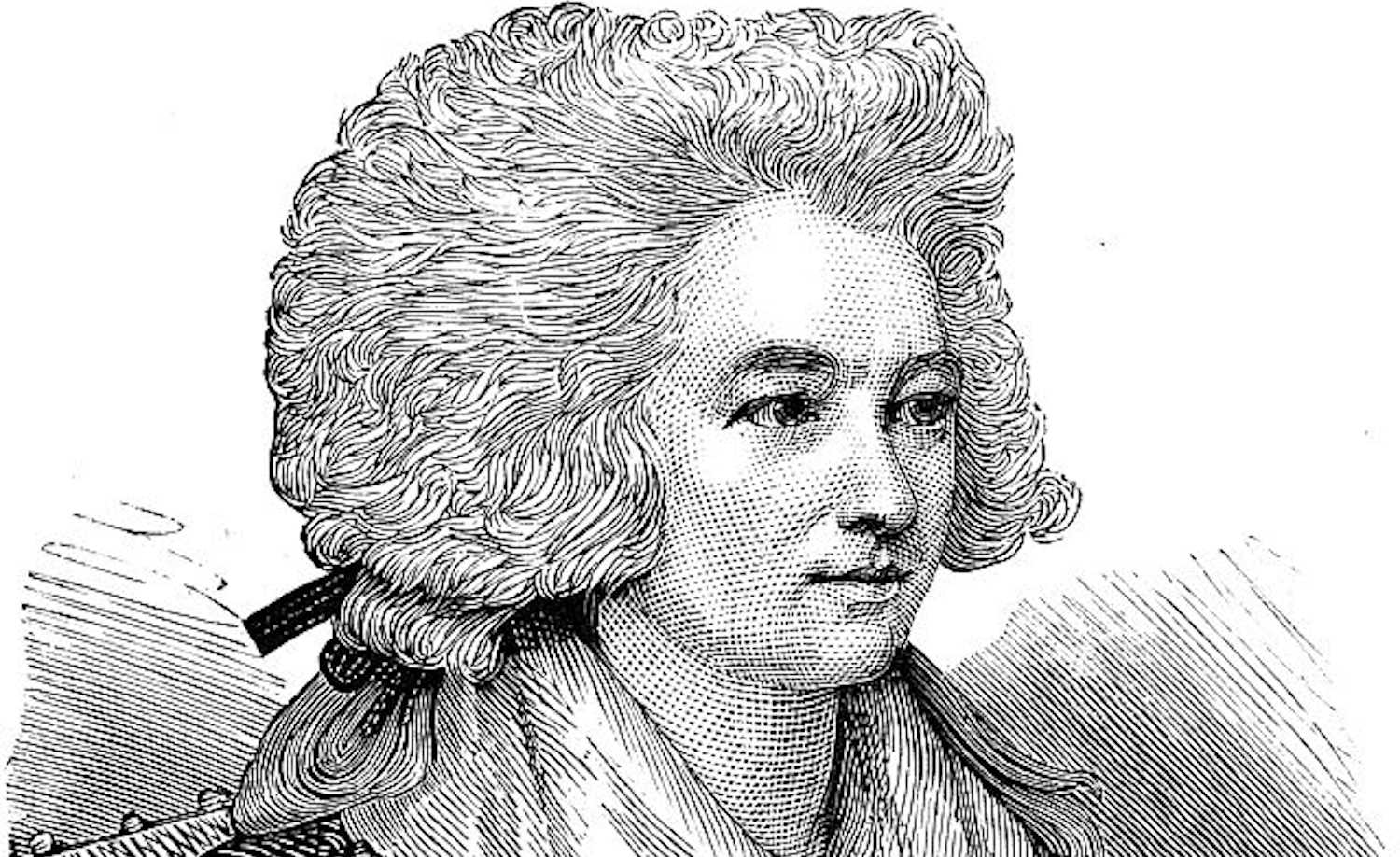
Hannah More: Sunday schools and education, writing and literacy, ending slavery and setting the scene for youth work. Hannah More was initially famous for her playwriting and involvement in ‘blue stocking’ circles. Later, her evangelicalism led her to philanthropy, writing popular religious tracts and pioneering work around Sunday schools and the end of slavery. Here, we examine these achievements and her contribution to the development of work with young people.
contents: introduction · hannah more – her life and works · sunday schooling · religious tracts and literacy · ending slavery · youth work · conclusion · further reading and references · links · how to cite this article
Hannah More (1745-1833) was ‘rediscovered’ towards the end of the last century, both as an early feminist and an anti-feminist. This focus on her beliefs about gender led to criticism that was ‘somewhat flat and one-dimensional’ (Lawless 1999). Hannah More’s philanthropic activities, her theories and practices as an educator, her involvement in pressure-group politics and the abolition of slavery, and her contribution to literacy studies are worthy of our sustained attention. Patricia Demmers (1996), for example, judged that she was the most influential female philanthropist of her day, and Anne Stott (2003) described her as the ‘first Victorian’
In this article, we examine, in particular, Hannah More’s:
- involvement (with her sister Martha) in the development of Sunday schooling;
- contribution to the development of literacy through religious tracts; and
- work with William Wilberforce and others to abolish slavery.
We also explore the suggestion that Hannah More was one of the important precursors of youth work (Young and Ashton 1956, and Milson 1979).
Over the last decade or so, several books have appeared that draw on previously unseen (or unreferenced) material on Hannah More. The most important of these was Anne Stott’s (2003) exploration of More’s character, friendships, thinking and accomplishments. Other contributions came from Karen Swallow Prior (2014) and a collection of material edited by Kerri Andrews and Sue Edney (2022) that arose out of a conference held at Hannah More’s former home, Barley Wood, in June 2019.
Hannah More – her life and works
Hannah More was born in Stapleton near Bristol in 1745. Her father, Jacob More, had been brought up in East Anglia and came from a reasonably wealthy background. Thanks to a poorly judged legal case, he lost what money he had. As a result, he made his way to Bristol to become the master of a foundation school there (in Fishponds). Hannah was the fourth of five sisters – all of whom developed strongly individual personalities. She was a ‘delicate’ child, ‘high-strung, easily stimulated, affectionate, and oversensitive to criticism’ (Hopkins 1947: 11). Jacob began training all his daughters to be teachers from an early age. However, he was somewhat ambivalent about this as he thought that female brains could be wrecked by too much ‘book learning’. On top of this, Hannah’s quick intelligence alarmed him. This said, as Karen Swallow Prior reports, ‘he displayed a liberality at odds with the age and more in tune with his daughters’ abilities, particularly that of Hannah (Prior 2014, introduction).
The three older More sisters decided to open a boarding school for ‘young ladies’ and set about establishing it. At the start of the venture, they were only nineteen, seventeen and fourteen. Opening in 1758 (at 6 Trinity Street, College Green, Bristol) and initially funded by subscription and with the support of Ann Lovell Gwatkin (the wife of a Bristol soap maker), the school was a success from the start. Its reputation as an ‘upmarket’ school soon spread. Within a short time, Hannah and her younger sister Martha also joined the staff.
Part of the school’s success lay in the sisters’ knack for making and developing contacts and friendships. The school attracted interest from a range of people. Charles and John Wesley became friendly with Hannah’s older sister, Mary and James Ferguson, the astronomer, and Thomas Sheridan (the father of the playwright) lectured at the school. In addition, Edmund Burke was a frequent visitor to the home the sisters established in Park Street, Bristol.
Hannah appears to have been a lively, quick-witted and charming young woman to the outside world. However, from an early age, she withdrew into periods of depression and ‘gave herself up to headaches, colds, bilious attacks and other functional illnesses’ (Hopkins 1947: 31). She met and became engaged at the age of 22 to a local landowner, William Turner. Some twenty years older than Hannah, he owned a large estate close to Bristol. Turner kept postponing the marriage. It is said that Hannah More’s ‘indifferent temper’ worried him, and in the end, after six years, an annuity of £200 per year was settled on her as a way of extricating himself from the engagement. Hannah went to Uphill, near Weston-super-Mare, to recuperate (she was said to be ‘recovering from an ague’, probably her body’s reaction to feelings of emptiness and depression) (Stott, 2003: 19). As a result of this experience, it is said that Hannah More resolved not to marry. She set about becoming a ‘woman of letters’ (the annuity gave her the material springboard for this) and moved out of school teaching. Later, she began calling herself ‘Mrs More’.
London, the theatre and essay writing
Hannah had been writing poetry for some time and had prepared a play for the young women at the sister’s school. Now she turned to the professional stage, and her first effort, The Inflexible Captive (later known as Regulus), opened at the Theatre Royal, Bath in 1775. She also began a series of annual visits to London. On the first, Hannah was accompanied by two of her sisters, and they took lodgings in Henrietta Street, which ran just behind St Paul’s Church in Covent Garden. They were introduced to London by Sir Joshua Reynolds and his sister Frances (who was also a portrait painter). Hannah More was also to take part in the conversation parties of the so-called ‘Bluestocking Circle’. Through her theatrical activities, Hannah More developed very significant friendships with David Garrick and his wife Eva (and often stayed in their house in The Adelphi). She also became friends with literary figures such as Dr Samuel Johnson, and later Horace Walpole. Hannah also started to deepen her capacity as an essayist and moral commentator. Her first publication in this area was published in 1777 (Essays on Various Subjects Principally Designed for Young Ladies). Over the next 14 years, the book went through five editions.
David Garrick saw Hannah’s potential as a playwright and identified the elements she needed to develop to be successful. He became ‘the supportive, encouraging father she had never had (Stott 2003, 27). Several plays followed, including Percy. A tragedy in 1777 (produced at Covent Garden Theatre and downloadable from Project Gutenberg), and later The Fatal Falsehood. David Garrick died of kidney failure in 1779, and Hannah went to stay with Eva Garrick in the Adelphi house. With Garrick’s death, Hannah More’s interest in writing for the theatre appears to have waned, and she began to rewrite Bible stories in dialogue form. Significantly, Hannah also started to lose interest in some of the social relationships that characterised the strata of London life in which she was involved. The deaths of Garrick, her father, and Dr Samuel Johnson (and some other members of her London circle) had saddened her, and she turned, in particular, to the Clapham Sect.
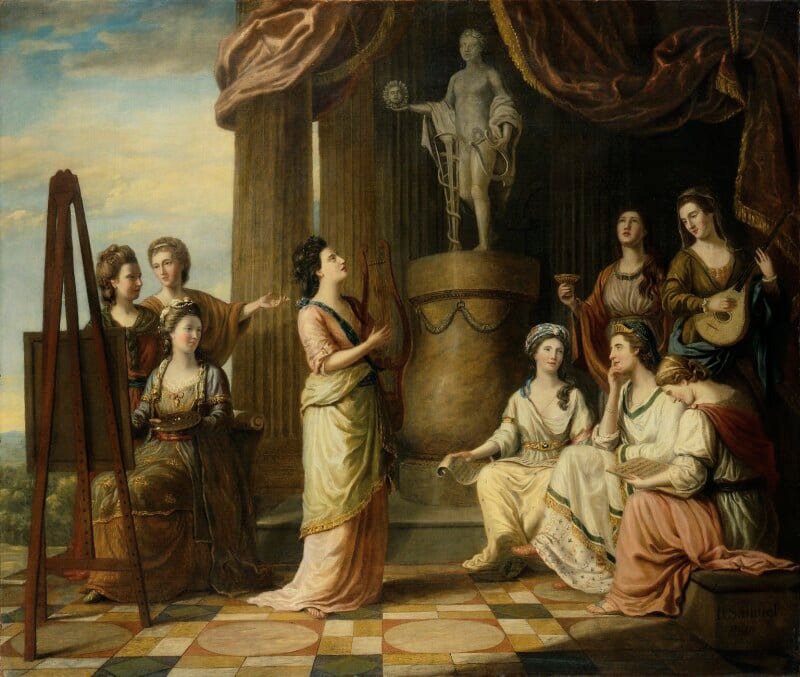
The Bluestocking Circle
The Bluestocking Circle (which essentially became the Blue Stocking Society) developed in the early 1750s. Three women are often described as the founders: Elizabeth Montagu (a writer and social reformer featured in the image above), Elizabeth Vesey (an Irish intellectual and London society hostess) and Frances “Fanny” Boscawen. On the whole, the two Elizabeths appear most frequently in the literature on the area; however, Frances Boscawen is of considerable interest. She was, initially, the wife of an admiral and, as a result, a significant political hostess. She knew Elizabeth Montagu and became increasingly involved in the Bluestocking Circle, particularly after 1761 when her husband died (Mascha Hansen undated). It also seems likely that the popular Bluestocking assemblies hosted by Frances Boscawen were Hannah More’s introduction to, and engagement with, the Circle. We also know she attended Elizabeth Montagu’s group.
Elizabeth Montagu summarised the doctrine of the Circle as “rational conversation” (In Our Time 2014). This involved debates that were not only intellectual, but led to moral improvement. In the case of the Bluestockings, this involved bridging the public and private (op. cit.). Another Elizabeth (Elizabeth Carter) involved in the group was an outstanding scholar and poet, who made a considerable and well-used contribution by translating the complete works of the Greek Stoic philosopher Epictetus (see, for example, The Enchiridion). Interestingly, Hannah More wrote a poem that epitomises the importance of conversation and connection – and includes some familiar names: The Bas Bleu: Or, Conversation. Addressed To Mrs. Vesey. This is one small section:
And Conversation’s setting light
Lay half-obscur’d in Gothic night.
At length the mental shades decline,
Colloquial wit begins to shine;
Genius prevails, and Conversation
Emerges into Reformation.
The vanquish’d triple crown to you,
BOSCAWEN sage, bright MONTAGU,
Divided, fell;–your cares in haste
Rescued the ravag’d realms of Taste;
And LYTTLETON’s accomplish’d name,
And witty PULTENEY shar’d the fame;
The Men not bound by pedant rules
Nor Ladies Precieuses ridicules;*
For polish’d WALPOLE show’d the way,
How wits may be both learn’d and gay;
And CARTER taught the female train,
The deeply wise are never vain;
And she who SHAKSPEARE’s wrongs redrest,
Prov’d that the brightest are the best.
One interesting feature of a number of the groups in the earlier years is that they included men as well as women. We can see this in Hannah More’s verses. For example, among Frances Boscawen’s guests were: Dr Samuel Johnson, James Boswell, and Joshua Reynolds. We also know that Gilbert West (the poet), Edmund Burke and Horace Walpole attended meetings. Another significant feature here is the work of Elizabeth Montagu and other participants in reinstating Shakespeare’s reputation as a playwright, following Voltaire’s earlier-in-the-century attack on him.
The Clapham Sect
The Clapham Sect gained its name because many of its members lived close to Clapham and worshipped in the parish church. Originally known as the Saints, they were an influential, but informal, group of wealthy evangelicals who sought to reinvigorate the Church of England with what could be described as a modified form of Methodism (‘vital religion’), and campaigns to abolish the slave trade. Its members included Henry Venn (1725-97), William Wilberforce (1759-1833) and Zachary Macaulay (1768-1838 – father of the historian Thomas Macaulay). They were strongly opposed to slavery and committed to missionary work. Macaulay, for example, had been appalled at the conditions experienced by slaves while he lived in Jamaica. The Sect was also involved in the foundation of the British and Foreign Bible Society in 1804. Hannah More was the only woman within the group who was there in her own right rather than through marriage or kinship (Stott 2003, Chapter 9).
William Wilberforce, in particular, was to become a very significant influence in Hannah More’s life. In him, ‘More found a counterpart’ (Prior 2014 Chapter 9). They had first met in Bath in 1786, and he became a regular visitor to her new cottage at Cowslip Green, Wrington, close by the Mendip Hills and, later, to her house about a mile away at Barley Wood (where Hannah was joined by her sisters). Significantly, it was on one of these visits in 1787 that Wilberforce announced that ‘something had to be done for Cheddar’. He had spent some time in the nearby village and came away resolved that action was required to improve people’s lives there. Besides the poverty, he was upset at the lack of spiritual comfort. In the discussions that followed, the idea emerged that the first step was to create a Sunday school. Two years later, Hannah and Martha More opened such a school in Cheddar, and in the next ten years or so, they set up more than a dozen Sunday Schools in the area.
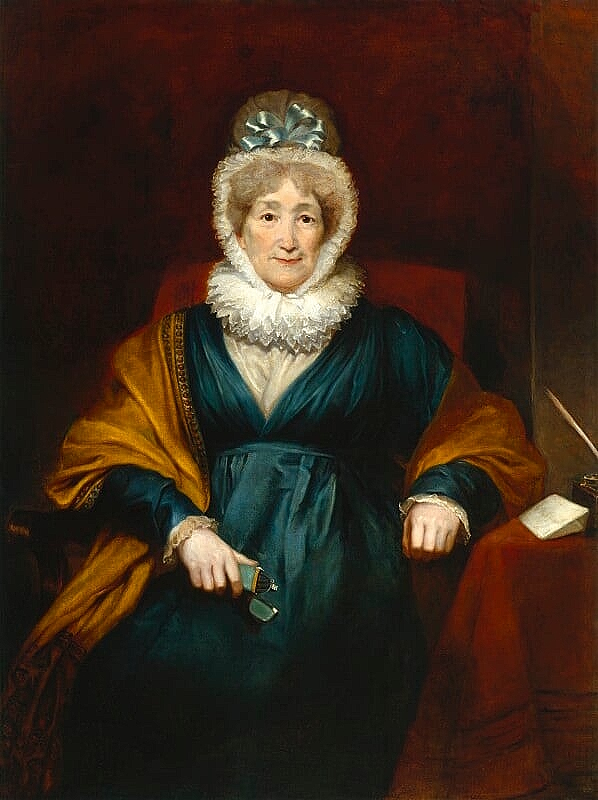
While concerned about physical and spiritual poverty, the sisters believed in the existing social order. ‘Beautiful is the order of society’, Hannah wrote, ‘when each according to his place, pays willing honour to his superiors – when servants are prompt to obey their masters, and masters deal kindly with their servants; – when high, low, rich and poor – when landlord and tenant, master workmen, minister and people… sit down satisfied with his own place’ (quoted by Simon 1964: 133). In this, we can see that the obligation went both ways. Duties were reciprocal (Bebbington 1989: 71). However, it still meant that her ‘plan for instructing the poor’ was ‘very limited and strict’. Hannah More continued, ‘they learn on weekdays such coarse works as may fit them for servants. I allow of no writing for the poor. My object is not to teach dogmas and opinions, but to form the lower classes to habits of industry and virtue’ (More 1859: 6). The framework for this activity was clear. ‘I know no way of teaching morals’, Hannah More wrote, ‘but by teaching principles, nor of inculcating Christian principles without a good knowledge of scripture’ (quoted by Young and Ashton 1956: 237). As we will see, she went on to write a large number of tracts that sold in great numbers.
A further crucial feature of the Clapham Sect was the major efforts members made to end slavery. As we will see below, they were central to the achievement of abolition.
The final years
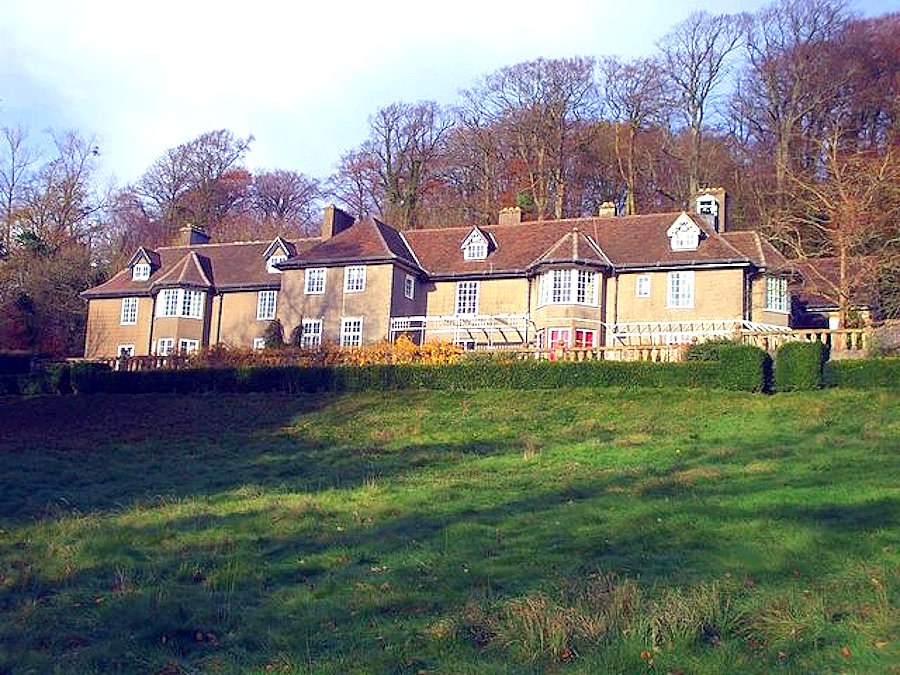

The More sisters lived together at Barley Wood in the Mendip Hills until Mary died in 1813. Theirs had been an extraordinary history – growing up together, working together, living together. The three other sisters died within a few years. By 1819, Hannah was alone. For some years, she suffered poor health, and she played out several deathbed scenes. She was rarely out of her bedroom, and the situation at Barley Woods appears to have got out of hand with servants cheating her. Eventually, she was persuaded to move to a house in Windsor Terrace, Clifton – close to friends who could keep an eye on things. Much of her time was spent dealing with the vast volume of correspondence arising out of people’s encounters with her work. She recognised that death wasn’t far off and began arranging the disposal of much of her fortune among various charities and religious societies. She became confused and died, aged 88, on September 7, 1833, and was buried with her sisters in Wrington churchyard (there is also a bust in the porch and a tablet in the church).
Hannah More and the development of Sunday schooling
Sunday schools emerged in the seventeenth century and were promoted and championed by Robert Raikes from 1780 on. Their orientation and methodology hit a particular chord – especially within evangelical groups. It is, therefore, not surprising that William Wilberforce and the More sisters should see Sunday schooling as a way forward. At Cheddar [in 1791, Hannah More wrote]:
… we found more than 2,000 people in the parish, almost all very poor—no gentry, a dozen wealthy farmers, bard, brutal and ignorant.. . . We went to every house in the place, and found every house a scene of the greatest vice and ignorance. We saw but one Bible in all the parish, and that was used to prop a flower-pot. No clergyman had resided in it for forty years. One rode over from Wells to preach once each Sunday. No sick were visited, and children were often buried without any funeral service. (from H. Thompson, (1838) Life of Hannah More quoted by Young and Ashton 1956: 237-8)
Wilberforce and More were appalled that this situation appeared to have been accepted by local worthies. Hannah More believed a significant, perhaps the key, factor in play was the lack of religious knowledge among the poor and a lack of moral teaching.
Hannah and Martha (Patty) More visited local people in Cheddar (from both farming and labouring families) before starting the school. They aimed to seek support and gather potential students. A house (for the schoolmistress) and barn (for the classroom) were obtained, and the school opened in October 1789.
At first even the reading was of the Scriptures only, though later she began herself to write stories, homilies and poems with a moral purpose, for she believed as John Wesley did, that it was no use to teach people reading, if all there was to read was the ‘seditious or pornographic literature of commercialism’. The object of the schools was also to make honest and virtuous citizens, and this was furthered by her various savings societies. At each meeting all the members, especially the women, were encouraged to deposit a little, even a penny a week, against the rainy day. This was used as a kind of insurance fund from which a sick contributor was able to draw out 3s. per week, while maternity grants of 7s. 6d. were available. She hoped also to raise the moral standard of the village by refusing membership of her schools to the non-virtuous. Girls found indulging in ‘gross living’ were to be shunned and excluded! (Young and Ashton 1956: 239)
Activities in the newly established school largely fell into two camps: those aimed at children and those concerned with adolescents and adults. Sunday was chosen as the main teaching day (hence the school’s name). It was a time when students and teachers would be relatively free of work and duties. Some classes were also held on weekday evenings – especially for mothers. Reading, knitting and sewing were the main activities. According to Young and Ashton (1956), she did not teach writing and cyphering, ‘maintaining that such accomplishments would breed sedition, and give the lower orders ideas above their station’ (1956: 238). This said, there was significant opposition to their activities from some local farmers, one of whom believed that ‘religion would be the ruin of agriculture’ – and that it introduced much mischief (Hopkins 1947: 164). [See also Anne Stott (2003), Chapter 7, for an overview of the development of the Mendip Sunday Schools.]
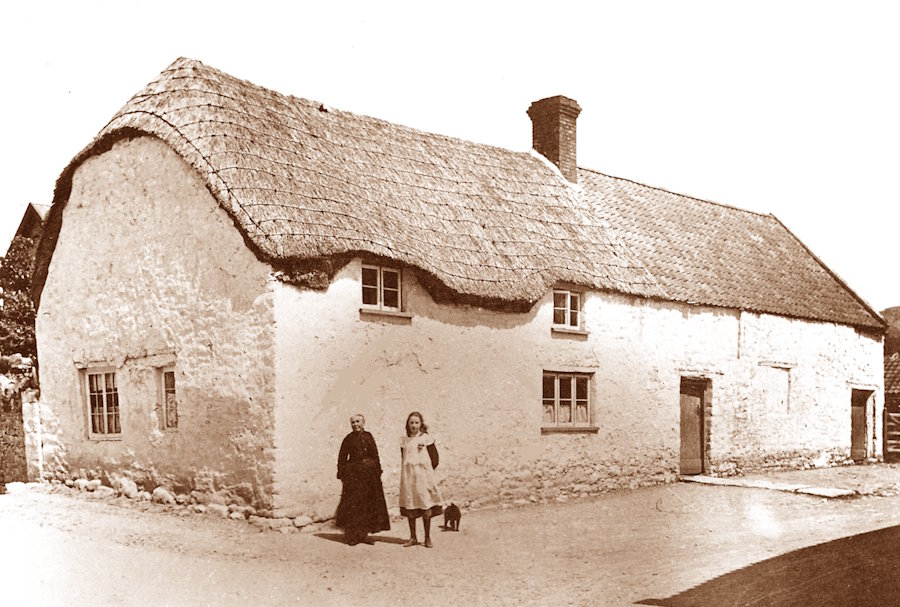
Alongside these schooling activities, Hannah and Martha More also encouraged community schemes. One example was building a village oven for baking bread and puddings (thus saving fuel). They also promoted and administered schools along the Cheddar model in several other villages. A large proportion of the funds supporting these schools came from members of the Clapham Sect.
The significance of Hannah and Martha More’s activities concerning Sunday schooling lay in the pedagogy they developed, the range of activities they were involved in, and the extent to which publicity about their work encouraged others to develop initiatives. Hannah and Martha More attempted to make school sessions entertaining and varied and to sideline rote learning. We can see this from the outline of her methods published in Hints on how to run a Sunday School (and reported in Roberts 1834). Programmes had to be planned and suited to the students; there needed to be variety, and classes had to be as entertaining as possible (she advised using singing when energy and attention were waning). She also argued that it was possible to get the best out of children if their affections ‘were engaged by kindness’. She also made the case that terror did not pay (Young and Ashton 1956: 239). However, she still believed it was a ‘fundamental error to consider children as innocent beings’ rather than as beings of ‘a corrupt nature and evil dispositions’ (More 1799: 44, quoted by Thompson 1968: 441). She was not above resorting to bribery:
I encourage them [she said] by little bribes of a penny a chapter to get by heart certain fundamental parts of Scripture…. Those who attend four Sundays without intermission receive a penny. Once in every six to eight weeks I give a little gingerbread. Once a year I distribute little books according to merit. Those who deserve most get a Bible. Second-rate merit gets a Prayer-book—the rest, cheap Repository tracts. (quoted in Young and Ashton 1956: 239)
This mix of methods and the somewhat questionable orientation around children’s nature did find an echo among many other evangelicals. When combined with the efforts of Robert Raikes and the formation, in 1785, of a non-denominational national organisation, the Sunday School Society, to coordinate and develop the work, we find some key elements of the basis for the amazing growth of Sunday schooling in the nineteenth century.
Controversy
Hannah More’s views and activities became the focus of a struggle between the evangelical wing of the Church of England (which looked to Sunday schools and similar activities as a way forward) and a more conservative wing that viewed such ‘Methodist’ activities as dangerous. As the Sunday school movement developed and Methodists became more organised, the reaction grew in strength. Known as the ‘Blagdon Controversy’, the initial spark was a Monday night meeting for adults associated with the Sunday school established by, and associated with, Hannah and Martha More. The session in question was, in essence, a prayer meeting at which people gave testimony. The local curate became deeply critical. Hannah More was accused of being Methodistic, and the situation became the subject of various letters to the press and more than 20 pamphlets over a period of four years (1800-1804). [add in other staff members] The temper of the debate rose with Hannah being represented, for example, as the founder of a sect [see Stott (2003) Chapter 11 for discussion of the Blagdon Controversy 1799-1803]. In the end, More had to close the Blagdon school. The controversy had affected her health, and she collapsed. Hopkins (1947: 198) comments that illnesses were Hannah’s rest periods. ‘She went into retreat from the world…. and believed that God sent her poor health to turn her toward Him’.
The continuing interest in and commitment to philanthropic activities have to be put in the context of the atmosphere of panic in the aftermath of the French Revolution.
[M]ost men and women of property felt the necessity for putting the houses of the poor in order… The message to be given to the labouring poor was simple, and was summarized by Burke in the famine year of 1795: ‘Patience, labour, sobriety, frugality and religion, should be recommended to them; all the rest is downright fraud’… The sensibility of the Victorian middle class was nurtured in the 1790s by frightened gentry who had seen miners, potters and cutlers reading Rights of Man, and its foster-parents were William Wilberforce and Hannah More. It was in these counter-revolutionary times that the humanitarian tradition became warped beyond recognition. (Thompson 1968: 61)
As Hopkins (1947: 203) has suggested, Hannah More’s view was that it was possible to make the poor physically comfortable by showing them to make better use of what they had, and ‘submissive by teaching them that joy in heaven was the recompense for deprivation on earth’. Alarmed at the growing influence of writers like Tom Paine and William Godwin, and at the prompting of the Bishop of London, she sought to write something that would open people’s eyes to the folly of notions such as liberty and equality. The result was her first tract: Village Politics, by Will Chip, a Country Carpenter. The book employed four basic arguments. That:
… the gentry look after the worthy poor; no relation exists between government and want; government is no concern of the common man; God knows what is best for his people. (Hopkins 1947: 208)
This was quickly followed by her response to Dupont’s speech in the National Convention, Paris, in December 1792, making the case for anti-religious public schools. Considerations on religion and public education; and Brief reflections relative to the emigrant French clergy (1793). [You can read and download this essay via Project Gutenberg.] Hannah More argues that education needs to be founded in faith; otherwise, there will be societal decay.
Hannah More, religious tracts and literacy
Kenneth Levine has noted that around the period that Hannah More was active, there were significant shifts in the working class. In particular, he suggests, it:
… separated into elements that assimilated ‘respectable’ cultural forms in school, work and worship, and those that embraced ‘subterranean’ traditions of autonomy, community solidarity and political dissent. At one, more institutionalized, pole lay the schools founded by the British and Foreign, National, and the various infant societies, the Sunday schools and the factory schools. To greater or lesser degrees, these offered literacy embedded in syllabuses and regimes intended to inculcate piety, discipline and obedience, as these virtues were perceived by the predominantly middle-class sponsors and organizers. At the more informal pole lay the private venture schools, the corresponding societies, the ale and coffee reading rooms, self-help and casual instruction from parents and friends, whole in an ambiguous middle zone lay institutions like mechanics’ institutes. (1986: 87)
Having looked to more formal avenues to educate the working and labouring classes, Hannah More turned to what she saw as the dangers associated with the other pole identified by Levine. As we have already seen, she was alarmed by the rise and widespread readership of radical writers like Tom Paine. The Rights of Man had sold in its thousands – and it, and books like it, helped to create a political consciousness, ‘among novitiate readers’ (Levine 1986: 89).
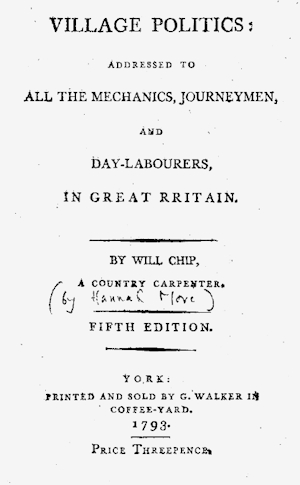 Hannah More’s first attempt to counter Paine’s influence – and that of the French Revolution – was the tract Village Politics. Addressed to all the Mechanics, Journeymen and Day Labourers in Great Britain, by Will Chip, a Country Carpenter (More 1792). This was a 5,000-word essay that compared the violence of the French Revolution with ‘the tried and tested virtues of the British political system’ (Stott 2003: 138). [You can read and download the fifth edition of the tract from the Internet Library.] It makes for interesting reading as it both defends the hierarchical nature of the situation and recognises the contribution that poorer people make to society. There is also some recognition that the franchise may be extended – and that the rich often had vices. Village Politics was published late in 1792, sold well, and was very well received by key figures such as Horace Walpole. It soon became known that the writer was Hannah More and not Will Chip.
The success of Village Politics encouraged More and other members of the Clapham group to produce the Cheap Repository Tracts (1795-98). These tracts, ‘imitated the lively style and also the format of the popular chapbooks or broadsheets’ (Kelly 1970: 78). They included readable moral tales, uplifting ballads, and collections of readings, prayers and sermons. More wrote and edited many of the tracts, while other Claphamites raised the money for printing and distribution (the tracts were sold at a little under cost). The first was published in March 1795, and the last some three years later. The tracts were published monthly and, overall, sold in the millions. Over 100 were produced – half of them by Hannah More.
Later, she explained her involvement in such writing:
… as an appetite for reading… had been increasing among the inferior ranks in this country, it was judged expedient, at this critical period, to supply such wholesome aliment as might give a new direction to their taste, and abate their relish for those corrupt and inflammatory publications which the consequences of the French Revolution have been so fatally pouring in on us. (More 1801 quoted by Kelly 1970: 78)
Hannah More, while not embracing the call for universal literacy, did recognise the importance of what might be called ‘popular functional literacy’. She also recognised a place for women (although not, as we have seen, in quite the terms we might expect today). Lawless (1999b) has argued that More’s language, ‘which stresses agency and value, elevates women’s status from passive objects to contributing members of society’. She continues, ‘though More works within the restrictive system of functional literacy that does not seek to liberate women from oppression, her moral, utilitarian educational approach ascribes agency and importance to women’.
Following on from the tracts, among other subjects, she produced three works that explored education:
Strictures on the Modern System of Female Education (1799) – which went through 13 editions and sold more than 19000 copies. [You can download Volume 1 from Google Books, and Volume 2 from the Internet Archive];
Hints for Forming the Character of a Princess (1805) – a far less popular book that was basically designed as a course of study for Princes Charlotte, daughter of the Prince of Wales. Volume 1 can be downloaded from the Internet Archive]; and
Colebs in Search of a Wife (1809) – Hannah More’s only novel. The book proved be very popular – selling more than 30,000 copies in the United States, for example, before More’s death. [You can download the novel from Project Gutenberg.]
These books have been a focus of debate over More’s view of women and their role. On the one hand, it can be argued that her view of women’s education was far more progressive than that of many others in the middle classes at the time.
She made many excellent observations on the subject, pointing out that it was unjust to keep women ignorant and scorn them for it, holding that education should be a preparation for life rather than an adornment; she advocated only for exceptional girls the classical education which she and her sisters had received. She would have the average girl trained in whatever ‘inculcates principles, polishes taste, regulates temper, subdues passion, directs the feelings, habituates to reflection, trains to self-denial, and more especially, that which refers to all actions, feelings and tastes, and passions to the love and fear of God’. She would have history taught to show the wickedness of mankind and the guiding hand of God, and geography to indicate how Providence has graciously consulted man’s comfort in suiting vegetation and climate to his needs. (Hopkins 1947: 230)
A counter-case is made by looking at the thinking of her contemporary, Mary Wollstonecraft. Though she may well have agreed with Hannah More that female education was deficient and required reform, Wollstonecraft proposed pursuing universal literacy. It was to be focused on the cultivation of reason, without prescribing the functional use of education. For Mary, education should enlighten individuals without restricting them to particular skills or reading materials (Lawless 1999b). With the growth in interest in Wollstonecraft’s work and the development in the 1970s and 1980s of feminist and more critical thinking around education, More’s approach was found wanting by some scholars (for an exploration of this, see Demers 1996). However, this was followed by several thoughtful and well-researched reappraisals of her thinking and work that paint a rather different picture (see, for example, Stott 2003, Andrews and Edney 2022 and Price 2014). Stott (2003, 223) rightly makes the important point that ‘in spite of the twists and turns, the contradictions and inconsistencies’, More’s message has a lot in common with Wollstonecraft’s.
Hannah More and ending slavery
William Wilberforce, Hannah More and others had been campaigning for change for some time. Wilberforce ‘had been troubled by the slave trade since his youth’ (Prior 2014 Ch. 8) and Hannah More had similarly made her anti-slavery views known in Slavery. A Poem (1788). The latter can be seen as a vital contribution. It helped to mobilise public opinion and to embed ‘abolitionist ideals into everyday life’ (The View Magazine, February 2026). Along with members of the Clapham Sect and others, she had highlighted the injustices of slavery:
… producing tracts and essays that reached wide audiences. Her work emphasised the humanity of enslaved people and the moral duty of Christians and citizens to oppose the trade.
Her pamphlet Slavery, A Poem (1788) was a powerful denunciation of the transatlantic slave trade, appealing to both reason and compassion. It was widely circulated and became part of the growing abolitionist literature that pressured Parliament to act (op. cit.).
Hannah More believed that slavery was the work of the ‘white savage’ who ruled by the ‘lust of gold’. She abhorred using skin colour to rob people of equal thought. She was able to translate this into a form that caught a number of key people’s attention.
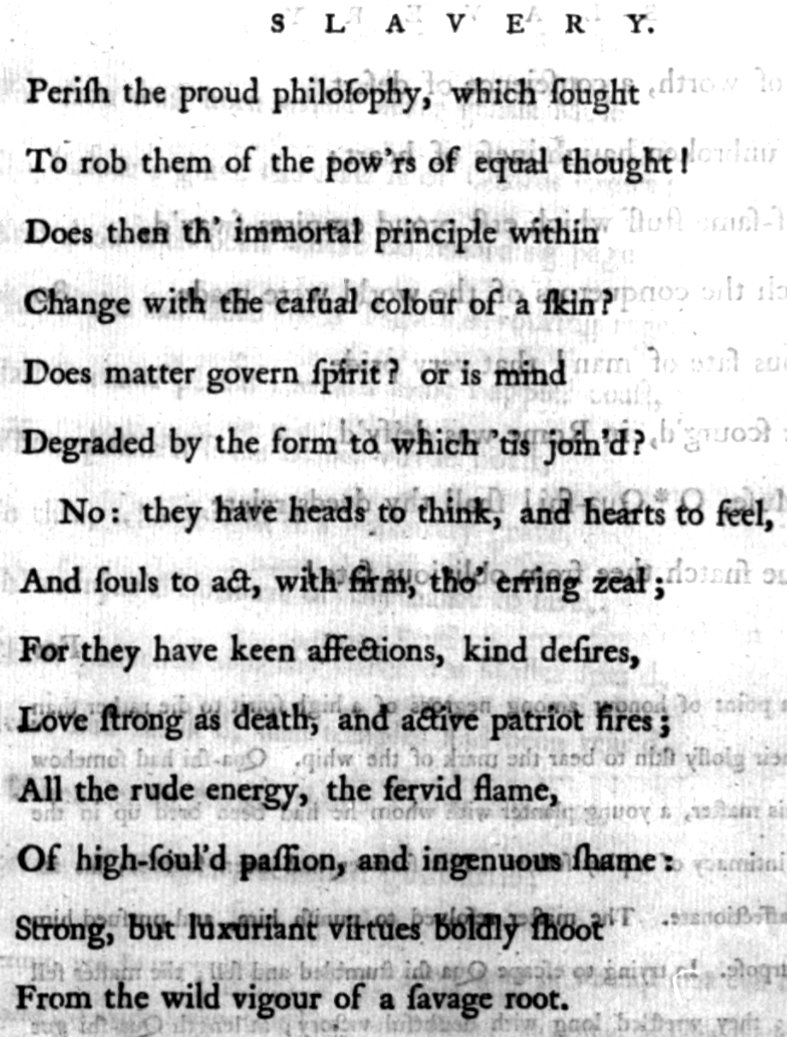
The poem was quickly written. More told her sister:
The slave cause gains proselytes and of course opposers, every day… My litle poem on Slavery is too short, and too much hurried; it of course will be very imperfect; foor I did not begin it till a fortnight ago. I would on no account bring it out so slight an so hasty a thing on nay less pressing occasion, but here time is everything (Prior 2014 Chapter 9)
Nearly twenty years later, a very significant step forward was achieved.
During much of this period, William Pitt the Younger had served as the Prime Minister and the Chancellor of the Exchequer [from 1783 to March 1801, and again from 1804 to 1805 (when he died)]. He described himself as an independent Whig, but is often portrayed as a Tory. Under him, much of the debt created by the American War of Independence was eliminated; income tax was introduced in Great Britain; many rotten boroughs were removed; and there was successful military action against Napoleon and France. However, his efforts to achieve parliamentary reform and to abolish the slave trade failed, but he had achieved some movement.
In 1784 William Wilberforce became an independent Member of Parliament for Yorkshire (and remained one until 1812). Working with his brother-in-law James Stephen and the needs of the Talents Ministry, he managed to introduce a bill after the death of William Pitt, ‘forbidding the import of slaves into captured enemy colonies and the fitting out of British ships to trade in slaves with foreign territories’ (Stott 2003, Ch.12). They had cleverly presented the bill as being in the country’s fundamental interests. This was because it denied foreign powers the ability to gain commercial advantage at the end of the wars underway. Such a focus gained additional supporters in Parliament and enabled the bill to become law (the Slave Trade Act 1807). As Stott noted (ibid.), the result was a reduction of around 75% in the slave trade.
Hannah More had, at this point, been suffering for eight months with a violent fever that contributed to her being ‘an observer on the sidelines’ (op. cit). That said, with the shift into the Parliamentary sphere, there was limited room for women’s intervention. Today, things are somewhat different. In recent years, Hannah More’s Slavery ‘has been at the centre of critical discussions about the abolition of slavery and its discursive legacies in Britain’ (Bridgen 2022). While her views reflected ‘a paternalistic outlook’, the “sober”, moralising voice she used enabled her, ‘to recast anti-slavery as a reasonable, not radical, cause which the country’s leaders ought to relinquish their resistance to, for their own sakes at least’ (op. cit.).
The final steps in the elimination of slavery linked to Great Britain began in 1833. This involved new legislation that came into force in August 1834, and applied to most British colonies. It resulted in something like 800,000 slaves being freed in the Caribbean as well as South Africa and a small amount in Canada (Historic UK). Unfortunately, it took until 1843 to include territories “in the possession of the East India Company, or Ceylon, or Saint Helena” (op. cit.). Just three days after the process began in 1833, William Wilberforce died. From around 1830, ‘the ravages of old age were becoming more apparent’ for Hannah More. ‘She was rapidly losing her once remarkable memory, and was confused when strangers visited her’ (Stott 2003, pages 330-1). It seems unlikely that she was able to take in the news of Wilberforce’s death and to appreciate the abolition of the slavery that remained in the British Empire.
Hannah More and youth work
Other women like Ellen Ranyard and Maude Stanley were to follow in her footsteps – but just what are we to make of Hannah More’s contribution to the development of different forms of informal education, especially youth work? Writing in the mid 1950s, Agnes Young and Elwyn Ashton argue that it is appropriate when exploring activity in the 1800s:
… to think of the development of youth work in two phases. The earlier one was closely concerned with teaching, and found its affinity with the educational movements of the day; while the latter part of the century saw the development of youth movements similar in many ways to the clubs of today.
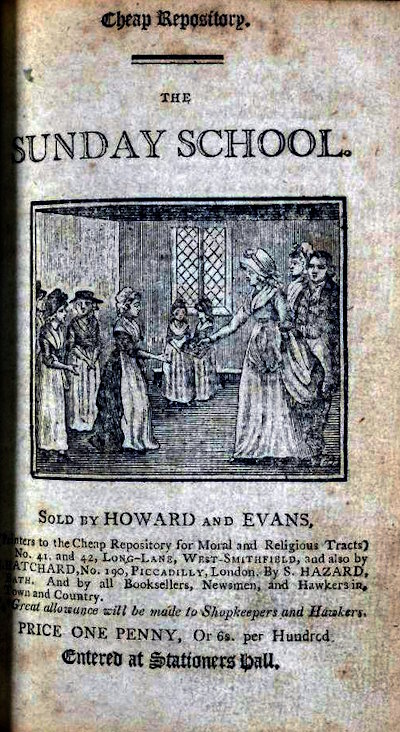
From this point of view, it is possible to approach aspects of Hannah More’s work – such as her development of Sunday Schooling around Cheddar as a precursor to what is later described as youth work. The approach being taken is outlined in More’s short piece The Sunday School, which appeared in the 1796-97 Cheap Repository series and is also discussed in her History of Hester Wilmott [click on the covers to download].
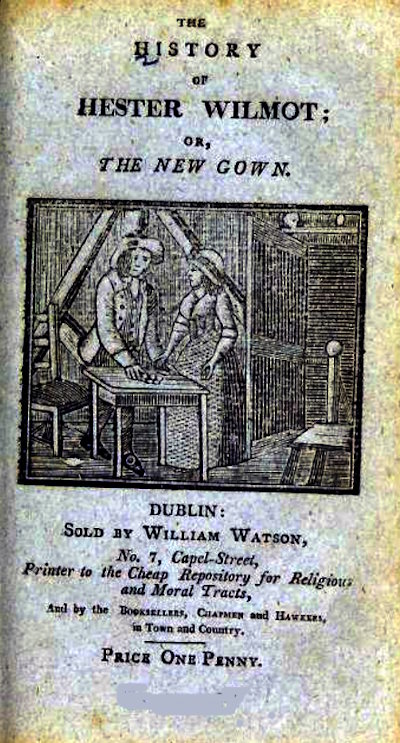
It can certainly be argued that she worked with young people, but significantly, they were only one part of the clientele she was concerned with. Hannah More was also interested in the education of children and adults, and both her writing and her Sunday school activities reflect this. To this extent, she can also be understood as a theorist and practitioner of lifelong education and learning.
Importantly, she and her sister worked with people on the basis of choice. While there were all sorts of incentives for children and young people, for example, to attend Sunday schooling, Hannah More recognised that they could not be compelled to take part.
Relative to the schooling activities of her day, Sunday schools associated with the More sisters had a more informal air and used a range of methods. There was more of a concern with creating the right atmosphere and relationship for learning. Besides classes, there were other community and welfare interventions, plus some concern with social life (and this was to be a feature of later Sunday school developments).
This said, the work that Hannah More was engaged in was some distance from what we later came to know as youth work. In particular, hers is an individualistic orientation. There is little recognition here of the significance of association, group and club – and her understanding of education is very firmly conditioned by her desire to convert.
Conclusion
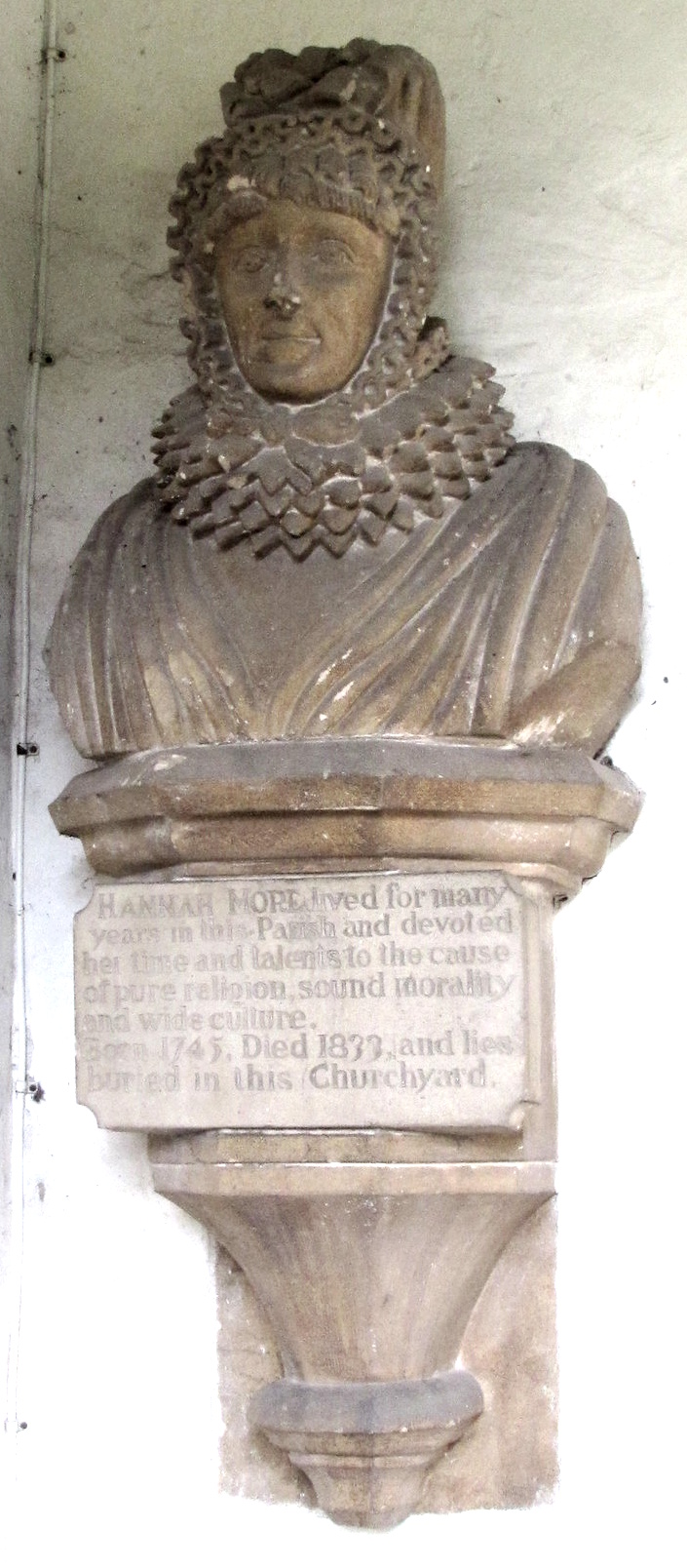
Hannah More was one of the best-known philanthropists of her day. Her development of Sunday schooling with her sister Martha, her employment of popular tracts, and her broader literary activities mark her as an important figure. She was one of the first women to achieve this sort of visibility via this route. As Bebbington (1989: 26) has commented, ‘In an age when avenues into any sphere outside the home were being closed, Christian zeal brought them into prominence’. Hannah More’s evangelicalism, like others in her group, took the form of individualist Christianity
… which allied faith hope and charity to national purpose… Though narrow in its theology and often conservative in its politics, evangelicalism was wide in its sympathies. This ‘vital religion’ was intensely emotional and left its adherents obsessed with human depravity and the ideal of Christian perfection, whose very elusiveness animated conduct. (Prochaska 1988: 22)
She could be said to have summed up the prevailing Evangelical attitude when she wrote: ‘Action is the life of virtue, and the world is the theatre of action’ (More 1808, quoted by Bebbington 1989: 12).
Hannah More remains a controversial figure. Her achievements were formidable, and her attitudes were paternalistic – but she was nevertheless an innovator and one of the first of a whole line of evangelical women philanthropists who helped to change the shape of social welfare in Britain.
Further reading and references
Andrews, K. and Edney, S. eds. (2022). Hannah More in Context. New York, NY: Routledge. An interesting collection of papers drawn from a conference held at Hannah More’s former home, Barley Wood, in June 2019.
Clark, N. (2000) Dr Johnstone’s Women, London: Hambledon and London. [Chapter 5 focuses on Hannah More]
Collingwood, J. & Collingwood, M. (1990) Hannah More, Oxford: Lion.
Demmers, P. (1996) The World of Hannah More, University of Kentucky Press. 192 pages. Examines more recent debates about More’s view on gender questions and argues for an appreciation of the full breadth of her work.
Eger, E. (2004) Boscawen, Frances Evelyn (1719–1805), Oxford Dictionary of National Biography, https://doi.org/10.1093/ref:odnb/47078.
Eger, E. and Peltz, L. (2008) Brilliant Women. 18th-Century Bluestockings. London: National Portrait Gallery.
Hansen, Mascha, (undated) Frances Glanville Boscawen, The Digital Encyclopedia of British Sociability in the Long Eighteenth Century [online], ISSN 2803-2845, Accessed on 08/10/2026, URL: https://www.digitens.org/en/notices/frances-glanville-boscawen.html.
Hopkins, M. A. (1947) Hannah More and her circle, London: Longmans. 274 + xv pages. Highly readable survey of Hannah More’s life and achievements.
In Our Time (2014) The Bluestockings, London – Radio 4. Hosted by Melvyn Bragg with guests: Karen O’Brien, Elizabeth Eger and Nicole Pohl. https://www.bbc.co.uk/sounds/play/b045c0h9.
Jones, M. G. (1952; 1968) Hannah More, Greenwood Press, New York.
Prior, K. S. (2014). Fierce Convictions. The extraordinary life of Hannah More. Poet, Reformer, Abolitionist. Nashville Tennesee: Nelson Books. An accessible account of Hannah More’s work and achievements that includes new material about her background and work.
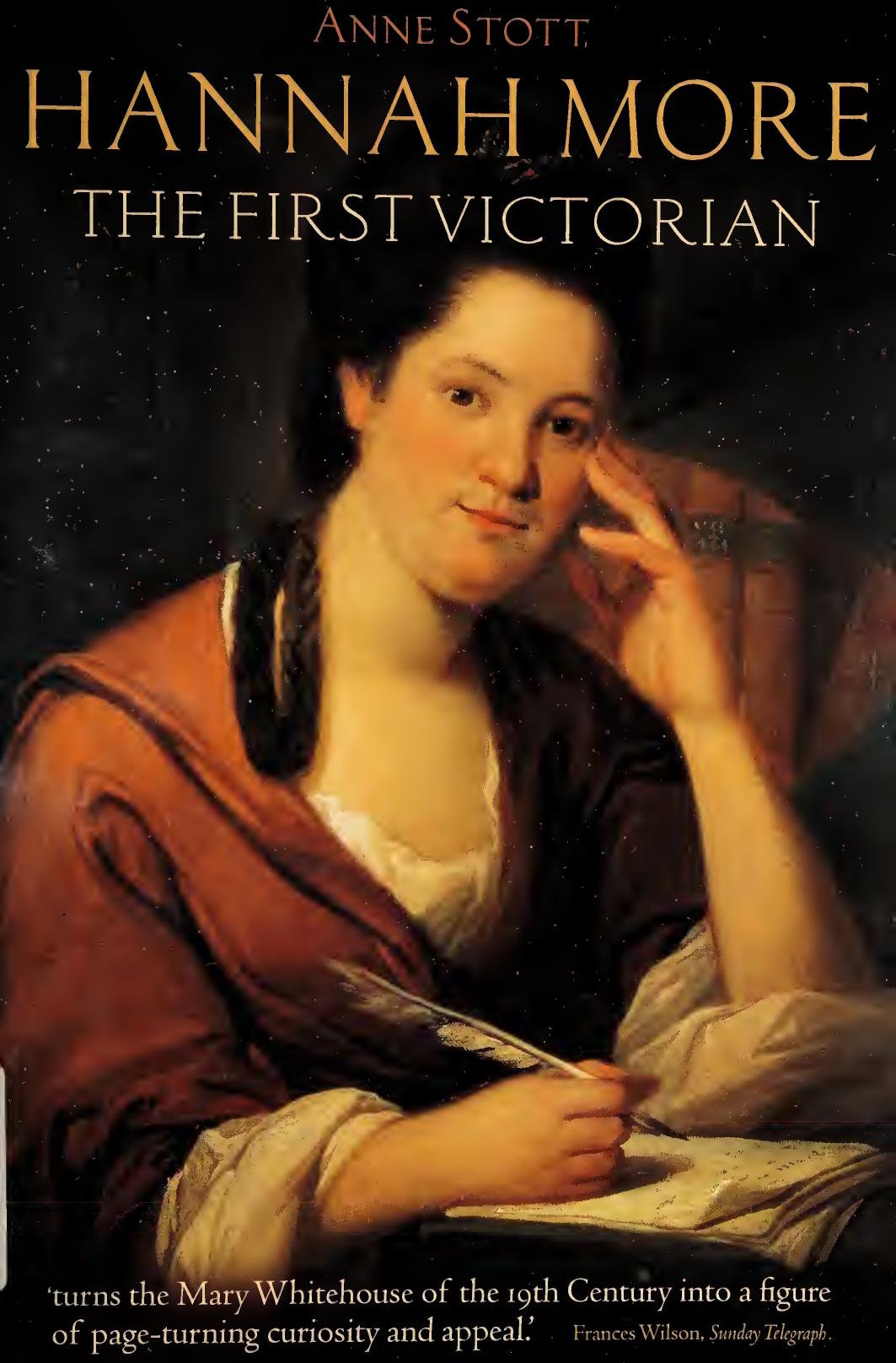
Stott, A. (2003) Hannah More. The First Victorian. Oxford: Oxford University Press. Anne Stott’s excellent book is a well-researched, thoughtful and balanced reappraisal of Hannah More’s life and achievements.
References
Altick, R. D. (1957) The English Common Reader: A social history of the mass reading public 1800-1900, Chicago: University of Chicago Press.
Bebbington, D. W. (1989) Evangelicalism in Modern Britain. A history from the 1730s to the 1980s, London: Routledge.
Bridgen, A. (2022) Defending “Reason’s rein”: Rationalism as Persuasive Strategy in Hannah More’s Slavery: A Poem (1788) in Kerry Andrews and Sue Edney (eds.) Hannah More in Context, London: Routledge.
Kelly, T. (1970) A History of Adult Education in Great Britain, Liverpool: Liverpool University Press.
Kowalseski-Wallace, E. (1991) Their Fathers’ Daughters, Hannah More, Maria Edgeworth and Patriarchal Complicity, Oxford: Oxford University Press.
Lawless, A. (1999a) ‘The Status of More Scholarship: Hannah More, Gender, and Literacy’, http://www.personal.psu.edu/users/a/s/asl141/hannahmore/scholarship.html. Accessed June 7, 2002. (No longer available)
Lawless, A. (1999b) ‘Hannah More, Mary Wollstonecroft and the politics of education’, http://www.personal.psu.edu/users/a/s/asl141/hannahmore/politics.html Accessed June 8, 2002. (No longer available)
Levine, K. (1986) The Social Context of Literacy, London: Open University Press.
Milson, F. (1979) Coming of Age, Leicester: National Youth Agency.
More, Hannah (1788) Slavery, A Poem, London: printed for T. Cadell. Available in the Internet Archive: https://archive.org/details/bim_eighteenth-century_slavery-a-poem-by-hann_more-hannah_1788/mode/2up
More, Hannah (1791, 1808) An Estimate of the Religion of the Fashionable World, London: printed for T. Cadell.
More, Hannah (1792) Village Politics, by Will Chip, a Country Carpenter, London: F. and C. Rivington.
More, Hannah (1793) Considerations on religion and public education ; and Brief reflections relative to the emigrant French clergy, London: T. Cadell.
Hannah More () The Sunday School, London: Sold by J. Marshall, printer to the Cheap Repository for Religious and Moral Tracts
Hannah More () The Sunday School, London: Sold by J. Marshall, printer to the Cheap Repository for Religious and Moral Tracts
More, Hannah (1798) Cheap repository (Cheap repository tracts, moral and religious tracts, by Hannah More and her friends, originally published in 1795-1798), London : Sold by J. Marshall, printer to the Cheap Repository for Religious and Moral Tracts
More, Hannah (1799) Strictures on the Modern System of Female Education; with a View of the Principles and Conduct Prevalent Among Women of Rank and Fortune, London: Printed for T. Cadell Jun. and W. Davies. (1990 edn. Oxford: Woodstock Books). Selections from this work are available on-line at the WORP archive: http://www.cwrl.utexas.edu/~worp/more/index.html
More, Hannah (1805) Hints for Forming the Character of a Princess, London: Printed for T. Cadell and W. Davies.
More, Hannah (1809) Coelebs in Search of a Wife: Comprehending Observations on Domestic Habits and Manners, Religion, and Morals, (1995 edn. Bristol : Thoemmes Press, 1995).
More, Hannah (1813) Christian Morals, London: Printed for T. Cadell and W. Davies.
More, Hannah (1843) The Complete Works of Hannah More. New York: Harper and Brothers. Available for download from The Internet Archive. https://dn760105.eu.archive.org/0/items/worksofhannahmor01more/worksofhannahmor01more.pdf
More, Hannah (1855) The Works of Hannah More. A new edition with additions and corrections (11 volumes), London: Printed for T. Cadell. Available from Google as digitised volumes (some are dated earlier than 1855).
More, Martha (1859) Mendip Annals, London: J. Nisbet and Co.
Myers, S. H. (1990) The Bluestocking Circle: Women, Friendship, and the Life of the Mind in Eighteenth-Century England, Oxford: Clarendon Press.
Prochaska, F. (1988) The Voluntary Impulse. Philanthropy in modern Britain, London: Faber and Faber.
Roberts, W. (1834) Memoirs of Life of Hannah More (2 volumes), London. (Available in the Internet Archive)
Roberts, W. (1835) Memoirs of Life of Hannah More (4 volumes) Third Edition – revised with an additional preface, London: B. Street and W. Burnside.
Scott, W. S. (1947) The Bluestocking Ladies, London W1: John Green & Co.
Simon, B. (1964) The Two Nations and the Educational Structure 1780-1870, London: Lawrence and Wishart.
The View Magazine (2026) Hannah More: Bristol’s Abolitionist Voice Against Slavery, https://theviewmag.org.uk/hannah-more-bristols-abolitionist-voice-against-slavery/, February 6, 2026.
Thompson, E. P. (1968) The Making of the English Working Class, Harmondsworth: Penguin.
Young, A. F. and Ashton, E. T. (1956) British Social Work in the Nineteenth Century, London: Routledge and Kegan Paul.
Acknowledgement: The opening image of Hannah More is from Wikimedia Commons. The picture is by unknown engravers, and is deemed to be in the Public Domain due to age, as per the relevant British legislation.
Thanks also to Tony Jeffs for lending me his extensive collection of material on, and by, Hannah More.
To cite this article: Smith, M. K. (2002, 2026). ‘Hannah More: Sunday schools and education, writing and literacy, ending slavery and setting the scene for youth work‘, The encyclopedia of pedagogy and informal education.[https://infed.org/dir/welcome/hannah-more-sunday-schools-education-and-youth-work/. Retrieved: insert date]
© Mark K. Smith 2002, 2026
updated: August 11, 2026